The 7-Year Cap in Korea's Standard Idol Contract
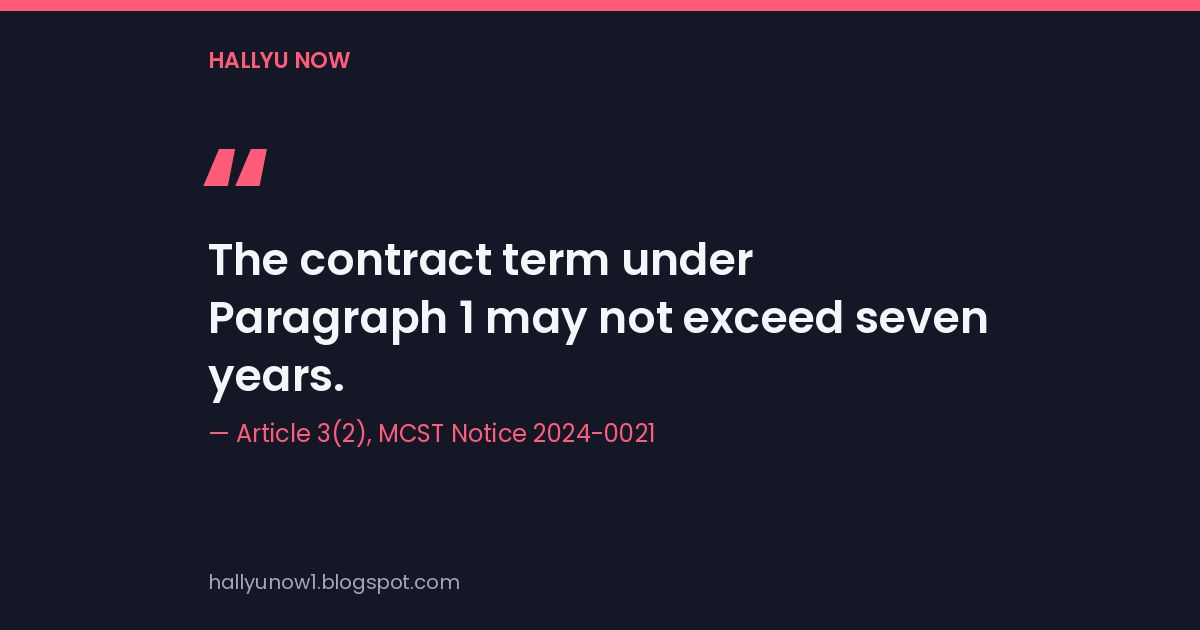
Seven years is the number every K-pop contract argument circles back to, and the sentence that sets it sits inside a government form. It is Article 3(2) of the 대중문화예술인(가수중심) 표준전속계약서, the standard exclusive contract for singers that the Ministry of Culture, Sports and Tourism issues as Notice 2024-0021, revised on June 3, 2024. Article 3(2) reads: "제1항에 따른 계약기간은 7년을 초과할 수 없다." The term set in Paragraph 1 may not exceed seven years, and any extension has to be agreed in writing by the agency and the singer.
The ministry's own press release for that revision has the form only as an attachment, and its file viewer would not open for me, so I pulled the same HWP file from KOCCA's standard-contract page and read it clause by clause. Everything below comes out of that file, with the Korean kept where the wording carries the weight.
What stops the seven-year clock
Under Article 3(3), seven years on paper can run longer than seven years on the calendar. If you have watched a group enlist member by member, this is the clause behind those drifting end dates. It lists five personal grounds that extend the term by however long they last:
- military service (군복무)
- pregnancy, childbirth and childcare (임신·출산 및 육아)
- graduate school or study abroad (대학원 진학, 유학)
- 30 or more consecutive days in hospital for reasons unconnected to entertainment work
- other cases where the singer's own responsibility makes the work impossible
The clause hands the arithmetic back to the parties, in the words "구체적인 연장 일수는 '기획업자'와 '가수'가 합의하여 정한다" — the exact number of extra days is something the two sides agree on. An 18-month enlistment therefore does not eat into the seven; it pushes the end date out by a stretch both parties have to settle between themselves.
Two more paragraphs of the same article rarely reach English coverage. Article 3(4) lets the parties write in how many albums are to be released inside the term, and the territory in Article 3(5) is 대한민국을 포함한 전 세계 지역, Korea plus everywhere else.
The exit price in Article 16
Under Article 16(1), either side has 14 days to fix a breach the other has demanded be corrected, with another 14 days available where the delay has a fair reason. Termination and a damages claim become available once that window closes.
Article 16(2) is where the eye-watering figures in Korean court coverage come from. If the agency has been performing its side and the singer breaches the contract in order to walk away (계약을 일방적으로 파기할 목적으로), the singer owes a penalty, 위약벌, separate from and on top of the damages in Paragraph 1: the average monthly revenue of the previous two years multiplied by the number of months left on the term. For someone under two years into activity, the average comes from the months that produced revenue. 매출액 there means gross revenue, so the multiplication runs on the top line before costs. Whether a court awards that full 위약벌 figure is a separate question, and I have not read the case law.
Two exits carry no penalty at all. Article 16(4) lets both sides end the contract by agreement when serious illness or injury makes the work impossible, and blocks the agency from claiming damages in that case. Article 16(5) lets the singer terminate and claim damages once a court has finally ruled that the agency, its registered officers, or its staff committed sexual harassment or sexual violence against them, with one proviso: where a staff member is the offender, an agency that proves it bears no fault is not liable under that clause.
When the money has to move
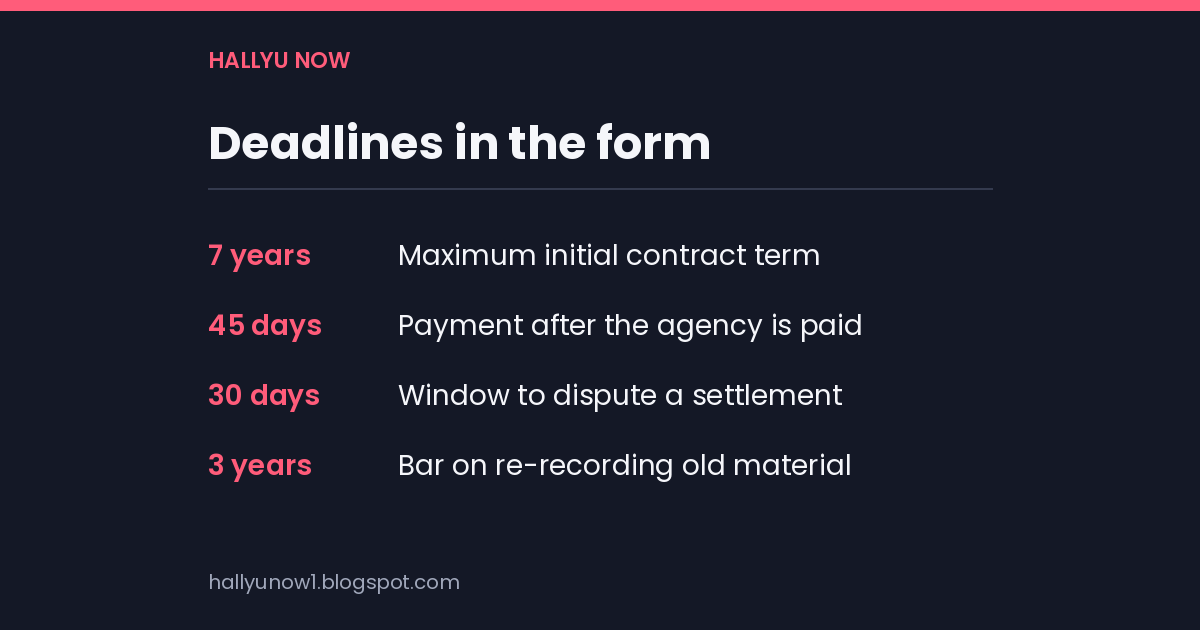
Article 12(6) puts a clock on payment. The agency pays the singer within 45 days of receiving a fee from a third party, and may push that out by up to 45 more days only where the delay has a legitimate cause. Article 12(7) requires the settlement statement to arrive with the payment, covering total income, the split, the method and the deductions, and gives the singer 30 days from receipt to object, with the agency obliged to show the basis for its figures. Article 12(8) leaves how often those statements come to the 대중문화예술산업발전법 rather than fixing a cycle in the form itself.
Group members get their arithmetic written down too. Article 12(4) divides the income under Paragraphs 2 and 3 equally by the number of members, unless the agency and that member have agreed something else. Article 13 lets an agency put training costs on the singer with consent and deduct them from later income, while instructing it to keep that burden "합리적인 정도를 벗어나지 않도록", inside a reasonable range.
What happens to the name
Article 8(1) lets the agency develop and register trademarks and designs in its own name during the term, using the singer's real name, stage name, group name, photographs, image, handwriting and voice. Paragraph 2 limits those rights to the agency's own business and the singer's work, licensing included. Paragraph 3 sends them back when the contract ends, to the singer in the case of solo activity, or on terms agreed between agency and members in the case of a group name. Paragraph 4 lets an agency that invested substantially in building the mark ask a fair price at handover, unless it already deducted that cost at settlement.
Publicity rights sit apart from the trademark. Under Article 9 the property and personal rights in a singer's identity belong to the singer, the agency holds an exclusive right to exploit them for the contract term only, and any use after the term needs a fresh written agreement.
Article 10(3) covers the old songs. For three years from the closing date, the singer may not produce or sell content substantially similar to what the agency created with them, and the example printed in the form is a re-recording of the same song. 문화일보 reported that the June 2024 revision stretched that bar from one year to three, alongside the new written-agreement requirement for extensions.
Why seven, and why agencies call it short
The form dates to July 6, 2009, when the Fair Trade Commission published the first version. 데일리안 traces the timing to the TVXQ dispute, where members challenged a 13-year contract and set off the "slave contract" controversy the piece describes as the trigger for the 2009 standard form.
That same December 2025 piece carries the industry's counter-case in numbers. Citing KOCCA figures for 2025, it reports that a fourth- or fifth-generation group now needs 평균 100억 원을 상회, over 10 billion won on average (about $7.3 million at the 1,360-won-per-dollar rate Google Finance showed on September 15), before it breaks even. An unnamed official at a large agency told the paper that the point where a company recovers its outlay and starts to earn has slipped from year two or three after debut to year four or five, which leaves the company two or three earning years inside the seven. An official at a smaller agency put the average cost of debuting one new team at 30억 to 50억 won, all of it fronted by the company. Yoon Dong-hwan, a 본부장 at 한국음악연대 (the Korea Music Alliance), is quoted saying the sums have grown large enough that recovering the principal alone takes more than three years. Bang Min-soo, chair of the recently launched idol union, wants a five-year ceiling instead, and says agencies either run the 99% who never get known around regional festivals to recoup the money or leave them idle, while not releasing them in case of a late 역주행 surge.
Those are figures from one outlet, a single KOCCA number plus quotes from people speaking for their own side of the table, not audited filings, and they count what a company puts in rather than what members take home. The union's proposal has changed nothing in the notice, which still reads seven.
I could not confirm how binding the form is. It is a 고시, a ministry notice, and every page I managed to open (the notice record, the press release, the 2009 policy archive entry) describes it as issued, revised and distributed without saying how far it binds an agency that drafts its own paperwork. Search summaries call it a recommendation, and I would rather leave that unconfirmed than state it from a snippet.
So if you have ever seen a real agency contract, the comparison worth making is Article 16(2). Does the penalty clause in that copy use the same two-year average multiplied by remaining months, or a flat number the company picked? The seven-year figure comes from this form; the paper a trainee signs is a different document, and we only ever see it when someone sues. Our earlier post on Xdinary Heroes' termination dispute is what one of those looks like from outside.
This is a running news series, not a one-off post — new stories go up twice a day, roughly 7am and 7pm Korea time.
More Korea coverage from our network: Korea Travel Planner · K-Sports Global · Korean Table · Seoul Skin Notes


Comments
Post a Comment