Why There Are Fewer New K-Dramas: 141 Titles Down to 107
Korean broadcasters and streamers put out 141 new K-dramas in 2022. Two years later the count was 107. If you have wondered why there are fewer new K-dramas turning up each season, start with those two numbers, then look at what a single episode now costs to make.
There is a tidy illustration of it airing right now. On September 19, JTBC gave its Saturday-Sunday slot to a drama that finished filming in 2021 and had its first broadcast in Taiwan in 2022.

What the Count Actually Says
The Korea Drama Production Association's tally, as reported by Edaily in April 2025, runs like this. Across TV and OTT there were 98 dramas in 2020, then 141 in 2022, then 123 in 2023, then 107 in 2024.
The same association's figure gets quoted a second way, and the two versions do not match. A Korea Journalists Association report from January 2025 says 2024 came in at "100편 남짓", a hundred or so, and that "30% 이상이 증발", more than 30% evaporated. Run the arithmetic on the year-by-year table instead and 141 to 107 is a 24% drop.
That second report also names a cause, and it is not the one fans usually reach for. Terrestrial and general-programming channels were hit by a shrinking broadcast ad market, so they cut drama commissions or filled the slots with variety shows, which cost less. Global platforms leaned harder into blockbuster variety at the same time.
Sixteen Episodes at 300 Million Won, or Ten at 15 Billion
Edaily's April 2025 piece reports that not many years ago a Korean drama ran about 300 to 500 million won per episode, and since the standard length was 16 episodes, a full series came in under 10 billion won. JTBC's own "SKY Castle" cost about 7.5 billion won in 2018. KBS2's "When the Camellia Blooms" cost about 11 billion in 2019, and "Descendants of the Sun" about 13 billion in 2016.
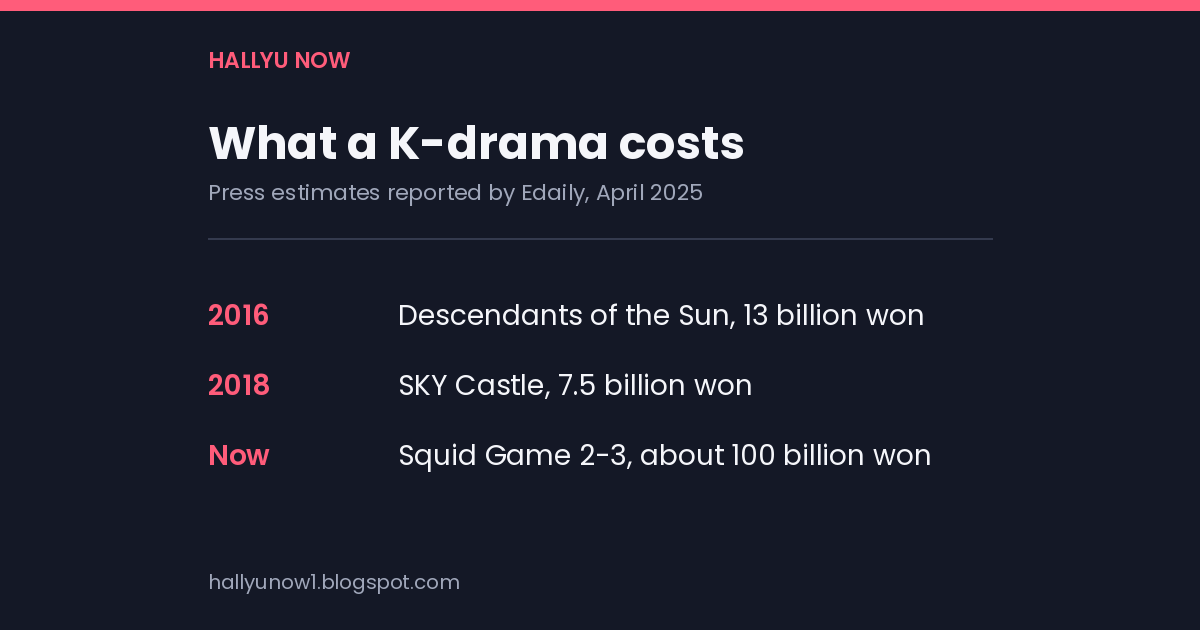
Now the current tier, which Edaily flags as industry estimates rather than disclosed budgets. Netflix's "Squid Game" seasons 2 and 3 at roughly 100 billion won, "Gyeongseong Creature" 1 and 2 at about 70 billion, Disney+'s "Moving" at about 65 billion, Netflix's "When Life Gives You Tangerines" at about 60 billion, tvN's "Queen of Tears" at about 56 billion, tvN's "When the Stars Gossip" at about 50 billion.
The benchmark that matters more for the average production sits in KOCCA's 2025 broadcasting industry white paper, quoted by Newsculture and Asiae. A ten-episode drama now averages 10 to 15 billion won. Divide that out and you get 1 to 1.5 billion won an episode, against the 300 to 500 million of the older model. Producers put the same jump to Edaily at more than three times what it was before COVID.

So when people ask why K-dramas have 16 episodes, the honest 2026 answer is that plenty of them no longer do, and the white paper's own benchmark is written around a ten-episode series. The next step needs care. None of these sources says shorter runs are caused by per-episode costs, and the association points at the ad market rather than at budgets for the commissioning drop. Which of the two moved first, I cannot tell from these documents.
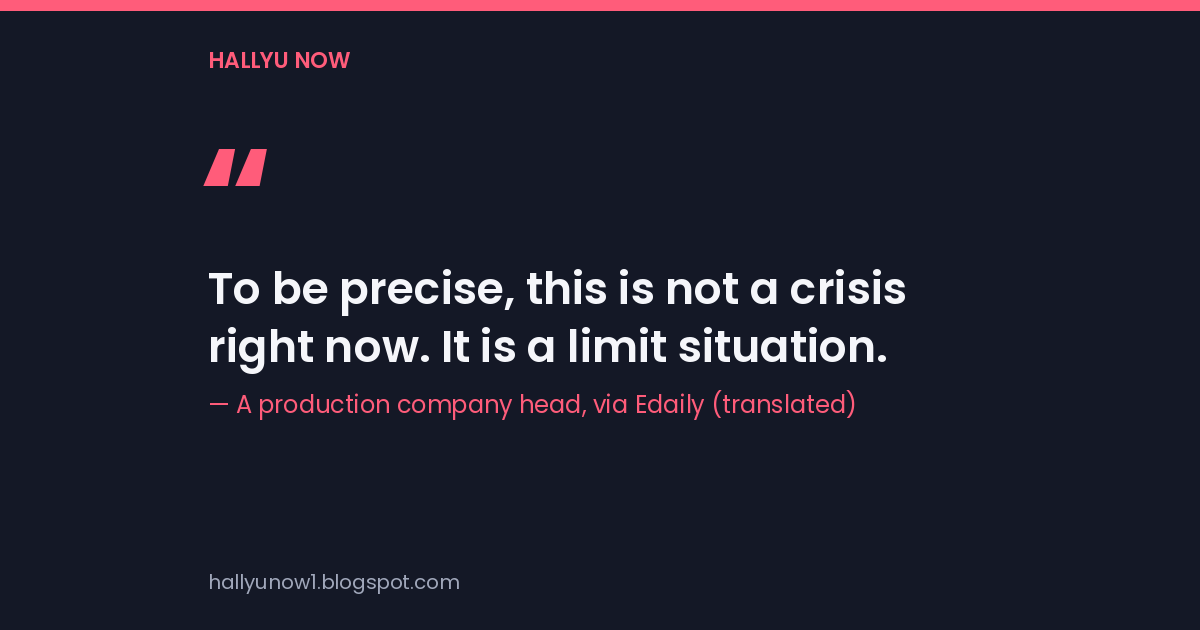
An unnamed production company head, identified in Edaily's article only as the head of company A, said the industry looks hard to survive without self-correction such as actors voluntarily cutting their fees. His summary of where things stand was "정확히 얘기하자면 지금은 위기가 아니라, 한계 상황". To be precise, this is not a crisis right now, it is a limit situation.
JTBC Is the Case Study
JTBC filed for court rehabilitation on June 15 this year. The Seoul Bankruptcy Court opened proceedings on August 28, and Etoday's report lists the causes the court gave: the rapid growth of domestic and foreign OTT platforms after COVID plus rising production costs, appearance fees and labour costs climbing while the broadcast ad market shrank against a growing digital ad market, a large short-term outlay for Olympic broadcast rights, and a liquidity crisis across JoongAng Group. The channel has to file its creditor list by October 8 and its rehabilitation plan by January 29, 2027.
What that looks like on screen is scheduling. The Herald Business, Herald Corporation's English edition, wrote on August 12 in a page it labels as machine-translated from its Korean original that JTBC "is reaching into its archive to fill a programming gap caused by production delays stemming from the broadcaster's financial difficulties." The channel re-ran "Joseon Matchmaking Agency: Flower Crew", a 2019 title, from August 22, and said it was "bringing out the drama jewel box 'Flower Crew' to fill viewers' weekend nights without a gap."
Then came the hair-salon drama that premiered September 19, which the Herald calls "Fly, Butterfly" while English Wikipedia files it under "Salon De Nabi", with "Fly High Butterfly" left as a redirect. According to Wikitree's write-up, production wrapped in 2021 for a first-half broadcast, a school-violence accusation against one cast member got the schedule cancelled outright, the accusation was later shown to be false, and the show went to Taiwan instead. Wikipedia lists that 2022 run on Chunghwa Telecom MOD, MyVideo and Hami Video, July 15 to September 2.
Nielsen Korea's nationwide household figure for episode one was 1.9%, and Wikitree's tally puts episode two at 2.1%.
Of the three weekend miniseries airing those nights, that opening episode was the lowest. tvN's "Four Hands" took the same slots with 6.8% and 7.9% for its seventh and eighth episodes, both series highs. KBS 2TV's "너 말고 다른 연애", roughly "a relationship with someone other than you", did 2.5% and 2.6%.
We wrote about Four Hands, Two Sonatas six days after it premiered on tvN. I have not watched the JTBC show and none of this is a verdict on it. A five-year-old title dropped into prime time does not open like a new one, and JTBC scheduled it anyway.
The Government's Answer Is a 30 Trillion Won Target
On September 10 the Ministry of Culture, Sports and Tourism announced its 7th medium-to-long-term plan for the broadcasting and video industry, covering 2026 to 2030. It arrived two years early, replacing a 6th plan written for 2023 to 2027.
Asiae gives the targets. Thirty trillion won in industry revenue by 2030, 3.06 billion dollars in content exports, and production companies with 10 billion won or more in annual revenue rising from 13.9% of the field to 27.8%. The 2024 actuals in the same article are 24.9944 trillion won in revenue and 1.2572 billion dollars in exports, so exports have to grow about 2.4 times in six years.
The mechanism aimed at the problem above is IP. The ministry ties a production company's ability to keep its own rights to its ability to fund the show, so funds, loans, tax support and production subsidies are all pointed at getting producers to where they can self-finance roughly 50% of an average drama budget.
What You Can Check Yourself
Two things help if you watch from outside Korea. When a Korean drama arrives on your service and the styling feels a season or two off, check its production year and its first broadcast territory before assuming it is new. The Wikipedia page above puts the 2022 Taiwanese run right in the infobox.
The annual drama count is published rather than guessed. The Korea Drama Production Association's tally gets reported each January, so the 2025 number lands in about four months.
Every production-cost figure in this post is a press estimate carrying 약 or 추정 in the Korean original. None of the articles cited here gives a title-level budget from a company filing.
What is the oldest "new" K-drama your streaming service has served you this year? I am curious whether the archive scheduling is showing up outside Korea yet.
This is a running series, not a one-off post — a new post goes up every day, at around 5pm Korea time.
About · Contact · Privacy Policy
Read next: Three K-Dramas Premiere at BIFF Before They Hit Netflix and Disney+ · 'The Ordinary Jackpot' Release Schedule and Its 3.9% tvN Start · Lee Chang-dong Films on Netflix by Country (No US Date Yet)


Comments
Post a Comment