Korean TV Ad Limit Goes From 17% to 20% on October 16
20% of a Korean channel's broadcast day can be advertising from October 16, up from 17%. The Korea Media and Communications Commission (KMCC, 방미통위) is bringing a revised Broadcasting Act enforcement decree into force that day, and the same decree lets a 30-minute program carry a mid-roll break. If you follow Korean TV schedules, this decree sets the ceiling for how many breaks they can hold.
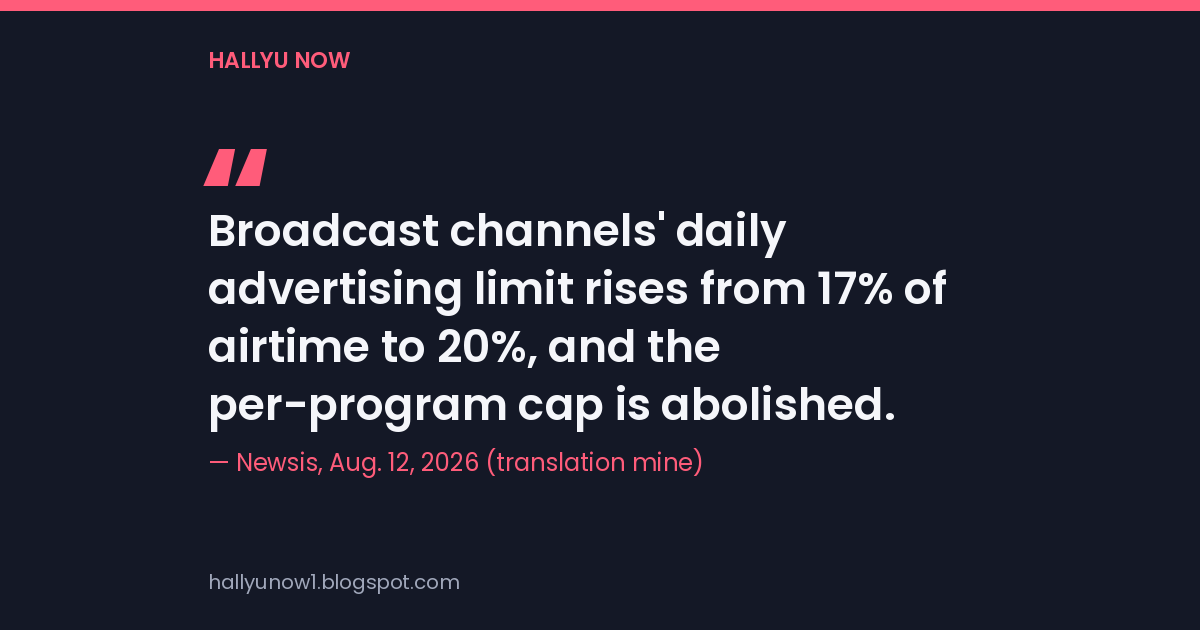
Start with the first sentence of Newsis's August 12 report on the commission's vote: "방송채널의 하루 광고시간 한도가 현행 방송시간의 17%에서 20%로 늘어나고, 프로그램당 광고시간 총량 규제는 사라진다." In English, a broadcast channel's daily advertising limit rises from 17% of airtime to 20%, and the per-program cap on advertising time disappears.
The second half is easy to miss. Per iNews24's September 30 report on the commission's briefing, the old method averaged each program's ad ratio, and the new one only checks that a channel's ads across the whole day stay under 20% of the time it actually aired. In the next sentence Newsis puts the minimum program length for a mid-roll at 30 minutes instead of 45, and calls the change "대폭 완화" (substantially eased) for broadcast ad rules from October.
Does a 20% cap mean 20% more ads?
No. It means three percentage points more, and the arithmetic is small. In one hour of airtime, 17% is 10.2 minutes and 20% is 12 minutes (my arithmetic). A channel on air for 24 hours goes from about 4 hours 5 minutes of advertising a day to 4 hours 48 minutes.
Prime time gets its own 20% limit. Newsis defines it as 7 to 11 p.m. on weekdays and 6 to 11 p.m. on weekends and public holidays, and says the separate limit exists so ads do not pile into one slot. iNews24 turns that into minutes: at most 48 on a weekday evening and 60 on a weekend or holiday evening. For reference, 7 p.m. KST is 6 a.m. US Eastern in October, my conversion.
Boundaries count by the second. iNews24's example is a 15-second ad that starts at 10:59:50 p.m., which adds only 10 seconds to the prime-time total.
The commission's chair, Kim Jong-chul, framed it as a balance in the Newsis and Money Today reports: "미디어 환경 변화에 따른 매체 간 비대칭 규제를 완화하고 방송시장의 활력을 제고할 수 있을 것으로 기대한다". He also asked broadcasters to work on "콘텐츠 품질 제고, 시청권 보호조치" (content quality and viewer-protection measures). Money Today's headline took the viewer's side more bluntly, "'볼만하면 또 광고' 더 늘어난다", roughly "just when it gets good, another ad, and there will be more". No viewer survey sits behind that wording.
Which programs can be interrupted, and how many times?
Newsis gives the whole table, and Money Today repeats it.
| Program length | Mid-roll breaks before | Mid-roll breaks from Oct. 16 |
|---|---|---|
| Under 45 minutes | none | allowed from 30 minutes (count not stated in the reports I read) |
| 45 to 60 minutes | at most 1 | 2 |
| 60 to 90 minutes | at most 2 | 3 |
The count follows the main program's actual running time. Per iNews24, mid-roll time is included in that running time, while ads before and after the program and fillers are left out. A K-drama episode with a 70-minute main broadcast would sit in the 60-to-90 row, so up to three breaks (my reading of the table; none of the reports mentions dramas).
Korean networks have been here before. In May 2017, The Korea Times reported that MBC's "Ruler: Master of the Mask" and SBS's "Suspicious Partner" each aired a one-minute commercial halfway through the first episode on May 10, followed by a notice that the next 35 minutes would resume. The paper wrote that public broadcasters could not run mid-show commercials under the law at the time. SBS replied that it counted each episode as two 30-minute programs, so the break was not a mid-show commercial. Viewers quoted in the piece were angry about the interruption and about the lack of advance notice.
That article is nine years old, and the reports I opened this week speak only of "방송채널" (broadcast channels) without separating terrestrial from cable. I also could not open the decree text, because my requests to the KMCC press page and to a law-site copy both failed on October 6. So which networks' dramas get a break first is not something I can tell you, and every number above comes from news reports of the commission's own announcements.

One more difference between the reports. Yonhap TV's June 12 summary (read through Nate) says the screen-size limit goes from a quarter to a third for PPL and virtual ads. PPL is the product placement you see in dramas. Newsis and Money Today report that quarter-to-third figure for virtual ads and for subtitle and data-channel ads, with no mention of PPL. ZDNet Korea says only that PPL and virtual-ad rules are eased, with no number. I would treat the PPL figure as unsettled.
Virtual advertising (가상광고) has its own genre change. Newsis says it was limited to entertainment programs, sports broadcasts and sports news, and now extends to 교양 (informational) programs. iNews24 adds that an economy-information program qualifies unless it counts as news, current affairs, commentary or debate.
Does any of this reach Netflix K-dramas?
Not according to how the commission describes it. In the Yonhap TV report of June 12, Yonhap TV reported the KMCC as saying that, compared with OTT and other digital platforms, relatively strict ad rules had applied only to broadcasters (the Korean is the reporter's indirect paraphrase, not a direct quote): "OTT 등 디지털 플랫폼에 비해 방송사업자에만 상대적으로 엄격한 광고 규제가 적용돼 왔다". The change is presented as narrowing that gap. Each report I opened, from Newsis to SBS News English, describes limits on broadcasters, and none of them says the limits extend to a streaming service.
I read that as meaning a Netflix original is not what this decree is about. I have not seen the decree's scope clause, so that stays a reading until someone shows the text.
A weekly drama that airs on a Korean channel and then streams is the case to watch. The channel's own broadcast falls under these limits; whether any streaming cut changes is something none of the sources addresses.
At its September 30 briefing the commission said it would post the main questions and answers on the KMCC site and the Community Media Foundation's site, and ZDNet says the briefing aimed to cut confusion as broadcasters apply the new standards to real ad scheduling. The decree takes effect on October 16.
This is a running series, not a one-off post — a new post goes up every day, at around 5pm Korea time.
About · Contact · Privacy Policy
Read next: What Time Do K-Dramas Come Out on Netflix? October-November 2026 · Dead-End Job Netflix Release Date and Its Korean Title, 꿀알바 · Trauma Code Season 2 Recasts Nurse Jang-mi With Jeong Ye-in


Comments
Post a Comment