Why K-Dramas Blur Knives and Cigarettes on Korean TV
The ready-made answer to why K-dramas blur knives and cigarettes is that Korean broadcast TV restricts such scenes and Netflix does not. 헤럴드경제 (Herald Economy) put the first half in one Korean sentence on June 27, 2026, "실제 현재 방송 드라마, 예능 등에서는 흡연 장면이 엄격하게 제한된다." In English, smoking scenes in broadcast dramas and variety shows are strictly restricted today.
The sentence sets up a point about streaming. The piece is about smoking scenes in Netflix originals, starting with 맨 끝 줄 소년, whose scene made it into the official trailer, and the sentence right after it turns to OTT, "반면, OTT에선 작품의 ‘리얼함’을 살리는 장치라는 주장과 함께 별다른 제재를 받지 않고 있다." By contrast, OTT escapes sanction, with the argument that smoking gives a work its realism. Several sentences later the piece says "방송에서는 규제로 나올 수 없는 장면들이 OTT에선 별다른 제재 없이 그대로 노출된다," scenes that cannot air on broadcast because of regulation are shown on OTT with hardly any sanction. Which regulation, the piece never says, so I followed it back.
Dec 9, 2015: an advisory for Reply 1988
The oldest case I found is a commission ruling on a broadcast drama. On December 9, 2015, 노컷뉴스 (Nocut News) reported that the Korea Communications Standards Commission (방송통신심의위원회, or 방심위) had given tvN's Reply 1988 (응답하라 1988) a 권고, an advisory that the article labels administrative guidance (행정지도). The meeting opened after a complaint that smoking in a show many teenagers watch was inappropriate. The vote was unanimous, and the scenes discussed included the character Sung Bo-ra smoking at a window while studying and on the living-room sofa, in an episode from the month before.
In the reporter's words, "방심위는 오후 10시까지로 지정된 청소년 보호시간대에 흡연 장면이 모자이크 처리 등 여과 없이 방송된 것은 심의 위반이라고 판단했다." The commission judged that airing smoking scenes without filtering such as mosaic, during the youth-protection hours that run until 10 p.m., violated its review rules. Mosaic appears there as one example of the filtering that was missing. I found no rule number cited in the report.
Oct 11, 2017: a commission official on the record
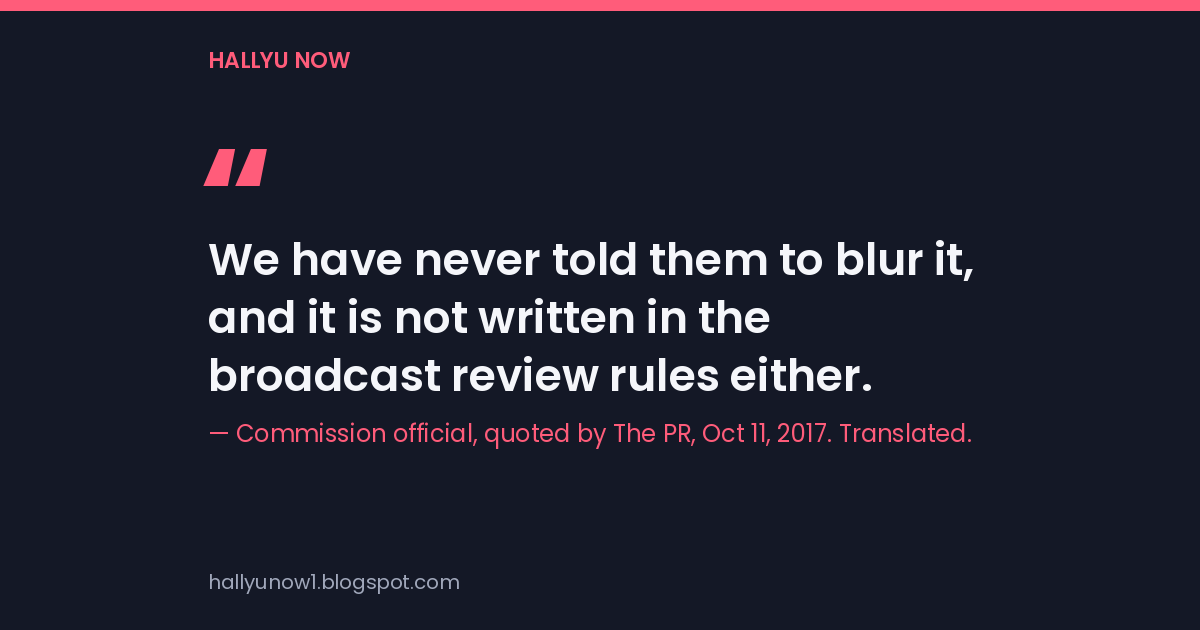
Nearly two years later, 더피알 (The PR) wrote about TV-aired films that showed actors smoking without the usual smear over that year's Chuseok holiday. Its reporter wrote, "현행 방송심의 규정에는 흡연 장면에 블러(blur, 편의상 모자이크로 표기) 처리를 해야 한다는 내용은 없다." The current review rules contain nothing saying smoking scenes must be blurred. A commission official told the outlet by phone, "저희가 (모자이크 처리를) 강제적으로 하라고 한 적은 없고, 방송심의 규정에도 적시돼 있지 않다." We have never told broadcasters to blur it, and it is not written in the review rules either. Broadcasters did it on their own, the official said, "자체적으로 주의하는 차원에서."
On where the habit came from, an unnamed broadcaster official said that, as far as they knew, terrestrial network presidents met "십여년 전 쯤," roughly a decade earlier, and agreed to blur smoking scenes, and it settled into a custom (관행) from there. The commission's films-only guidance is also secondhand. Several unnamed broadcast staff told the outlet that it advised broadcasters not to blur smoking in films, since films count as art, and that dramas and variety shows kept the old practice. The advice came in July 2016, my arithmetic from the article's 2017 date and its phrase 지난해 7월 ("last July").
A broadcaster official described a re-run of a film that had been blurred earlier. The commission called to ask "왜 또 모자이크 했느냐," why it had been blurred again. Erasing an old blur is harder and costs more, the official said, and the broadcaster had told the commission that old edits would go out as they were while newly aired films would not be blurred. On enforcement, the commission official quoted by The PR said, "TV에 방영되는 드라마나 영화에 흡연 장면이 있다고 무조건 제재하는 것은 맞지 않다."
Put the 2015 advisory next to the 2017 phone call and the pieces fit. Unfiltered smoking before 10 p.m. drew a complaint and an advisory once, and the commission says it never ordered a blur, so a broadcaster that wants no complaint on file has its own reason to keep blurring. I am inferring this, and neither article says it in those words.
2014 text: Articles 28 and 38(2)
The only full copy of the rules I could read is a Wikisource transcription of the version dated January 15, 2014 (commission rule no. 100). Article 28 tells broadcasts to take care with content such as "음주, 흡연, 미신, 사행행위, 허례허식, 사치 및 낭비풍조 등의 내용," and the sentence ends "신중을 기하여야 한다," meaning they must be careful. Article 38(2) is the one that names weapons (흉기), and it reads "방송은 범죄의 수단과 흉기의 사용방법 또는 약물사용의 묘사에 신중을 기하여야 하며, 이같은 방법이 모방되거나 동기가 유발되지 않도록 하여야 한다." Broadcasts must take care when depicting the means of a crime, how a weapon is used or drug use, and keep those methods from being imitated or a motive from being provoked. I searched the transcription's raw text for 모자이크 and 블러 and found no match.
The transcription uses 흡연 in two places. Article 28 is one. Article 45(4) is the other, and it says broadcasts must not depict children and teenagers smoking or drinking, and must take care even where the story makes it unavoidable.
The 2017 and 2022 articles both quote Article 28 with a clause the 2014 transcription lacks, "이를 미화하거나 조장하지 않도록" (so as not to glamorize or encourage it), so Article 28 was apparently reworded after that edition. In both wordings the duty is care. I could not read the commission's own copy of the current rules, and the national law portal gave me no rule text. I ran one Korean search for a commission statement on blurring newer than 2017 and got OTT commentary instead.
Nov 8, 2022: one weapon, two rulebooks
The knife half of the question comes from a student-reporter piece in 오마이뉴스 (OhmyNews), written at Hallym University's media lab and dated November 8, 2022. In its examples, tvN's 블라인드 (Blind), rated 19+, put a "전체 모자이크," a full mosaic, over a weapon used to hurt someone in episode 1, and JTBC's 인사이더 (Insider), same rating, mosaicked part of a blunt weapon. On Netflix, contestants in 오징어 게임 (Squid Game) hold knives, shown "여과 없이" (unfiltered), and the article says characters in 수리남 (Narco-Saints) swing axes and knives with no mosaic.
The student reporter's explanation is a legal split. The piece gives its reason in one sentence, "OTT 콘텐츠는 관계 법령인 정보통신망법에서 흉기 묘사에 대해 아무런 규정을 하고 있지 않기 때문이다." That is, the Information and Communications Network Act, which the piece says governs OTT content, has no provision on depicting weapons. The piece puts the weapon clause under 방송법 제38조(범죄 및 약물 묘사), the Broadcasting Act, but the heading in parentheses matches Article 38 of the commission's review regulation, so the label looks like a slip. The wording it paraphrases, "범죄의 흉기 묘사에 신중히 처리해야 한다," is the same take-care duty as 38(2), with no mention of mosaic.
Ratings follow the same split in the OhmyNews piece. "TV 방송 기준으로는 19세 판정을 받아야 할 장면이 OTT에서는 15세 관람가 판정을 받는 등," scenes that would need a 19 rating by TV standards can get 15+ on OTT. The smoking pair makes it concrete. JTBC's Nevertheless (알고 있지만) has a scene where a hand covers the cigarette so the smoking is not shown, while Netflix's D.P., rated 15+ like it, shows characters lighting and smoking cigarettes with no on-screen treatment in 5 of its 6 episodes.
If you watch K-dramas outside Korea, my hypothesis is that a gray patch over a knife or a cigarette means the episode aired on a Korean channel first, because the blurred shows above are tvN and JTBC dramas and the unblurred ones are Netflix originals. It rests on a handful of examples from one article. Which title breaks the pattern?

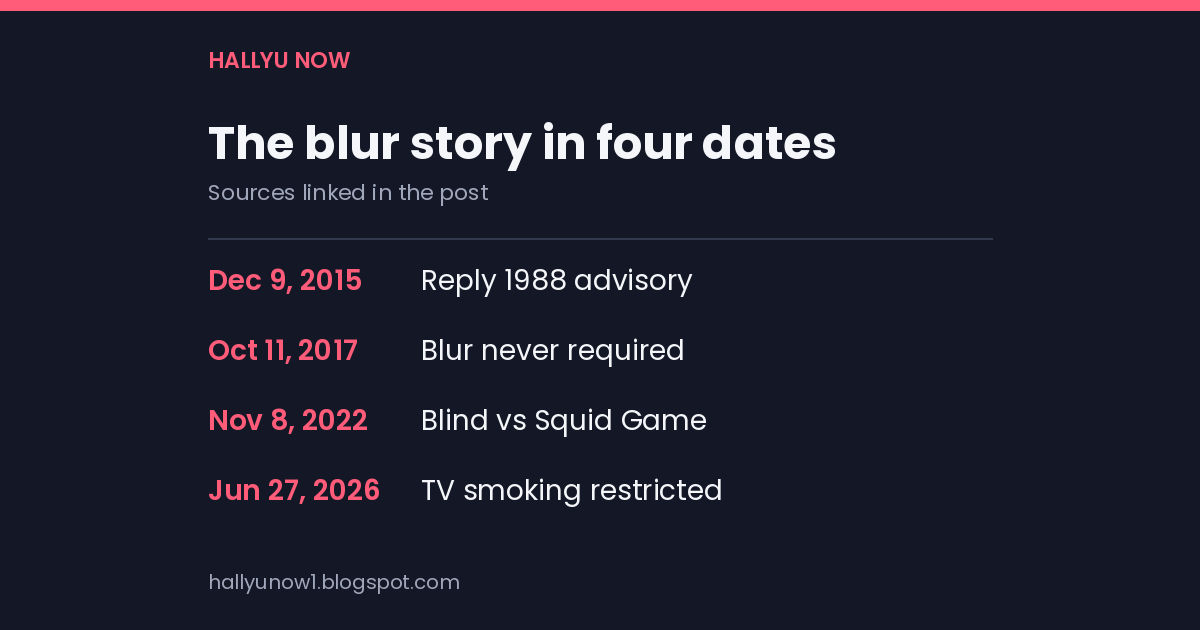
June 27, 2026: the bill
The Herald piece ends on a bill from Democratic Party lawmaker Choi Min-hee, the 시청각미디어서비스법안 (audiovisual media services bill), whose core is extending the legal framework beyond broadcasters to YouTube and OTT platforms.
This is a running series, not a one-off post — a new post goes up every day, at around 5pm Korea time.
About · Contact · Privacy Policy
Read next: What Time Do K-Dramas Come Out on Netflix? October-November 2026 · Dead-End Job Netflix Release Date and Its Korean Title, 꿀알바 · Trauma Code Season 2 Recasts Nurse Jang-mi With Jeong Ye-in


Comments
Post a Comment